











































%20(1)-1060x400w.png "Is Your Visitor Book GDPR Compliant?")
Published 23 July 2018
Last Updated 24 July 2026

Is Your Visitor Book GDPR Compliant?
If your reception desk has a paper sign-in book, you’re probably already breaking UK data protection laws. A lot of businesses have no idea this problem exists until a data protection officer or auditor points it out. Here is why it matters, what the law actually requires, and how to comply with GDPR laws and protect visitor data.
What GDPR Has to Do with a Visitor Book
The General Data Protection Regulation, retained in UK law as UK GDPR post-Brexit, applies to any organisation that collects and processes personal data. A visitor's name, the company they work for, their vehicle registration, their phone number, the person they're visiting: all of it counts as personal data. The moment your visitor book captures any of these, you are a data controller, with legal obligations attached.
GDPR requires businesses to handle personal data lawfully, transparently, and only for a specific stated purpose. That applies to a notebook on a reception desk just as much as it applies to a CRM database. The regulation makes no exception for paper-based records.
The ICO (Information Commissioner's Office) is the supervisory authority in the UK, and it has the power to issue fines of up to £17.5 million or 4% of global annual turnover for serious breaches. Most visitor book problems would not reach that level, but the accountability framework is the same regardless of scale.
The Specific Problem with a Paper Sign-In Sheet
The core issue with a standard paper sign-in sheet is visibility. Every new visitor who approaches the desk can read the names, employers, and contact details of every person who signed in before them. That is a data breach. The visitor has given their personal data to your business, and your business has immediately exposed it to a waiting room full of strangers.
A confidential visitor sign-in book with a folded or blacked-out format addresses this to a degree, because each entry is hidden from subsequent signatories. But even a confidential design does not solve every problem. The book still sits on a reception desk, it can be left unattended, and it does not enforce deletion, retention limits, or access controls automatically.
What a GDPR Compliant Visitor Book Actually Requires
For a paper-based visitor book to be broadly aligned with GDPR requirements, several conditions need to be met. None of them are technically difficult; they just require active management.
Transparency and consent
Visitors must know what personal data you are collecting, why, and how long you will retain it. This typically means displaying a short privacy policy notice at the sign-in point. Obtaining consent in the right form is also a consideration: if your lawful basis for processing is consent, that consent must be freely given and specific.
Data minimisation
Collect only what's necessary. A visitor's name, the time and date of their visit, and who they are meeting will cover most legitimate business needs. Vehicle registration is defensible if you manage a car park with security controls. A full home address almost certainly isn't.
Retention and deletion
UK GDPR does not permit you to retain personal data for longer than necessary. Old visitor books need to be securely destroyed once they fall outside your defined retention window. Many businesses hold onto old books indefinitely; that is not compliant.
Physical security
Visitor data on paper must be stored securely when it's being actively used. A sign-in book left unattended on an unmanned desk with no cover, in a space accessible to the public, is an open risk for unauthorised access.
Get all four right, consistently, and a paper visitor book can be broadly compliant, but it is still an imperfect system for capturing visitor data.
Where the Paper Visitor Book Fundamentally Struggles
You can run a reasonably compliant paper-based process if you are disciplined about it. The difficulty is that the compliance depends entirely on the humans managing it, not on the system itself.
A visitor has the right to access their personal data, request corrections, and ask for deletion. If someone who visited your premises six months ago submits a Subject Access Request, you need to find their record, confirm it's theirs, and act on their request within one calendar month. In a series of paper books held across multiple sites, that's a difficult process to manage.
There is also no audit trail for who has viewed the book, when entries were made, or whether the retention procedure was followed. If a data breach occurs and the ICO investigates, you need to demonstrate your compliance process. "We have a book at reception" is not a defensible answer.
The right to erasure is another sticking point for paper visitor books. Anyone who has ever provided their information to you has the right to ask you to erase their details from your records. Manually locating and deleting a specific individual's data from a paper record is impractical at any scale. While digital visitor management makes this really straightforward.
How Digital Visitor Management Solves These Problems Systematically
A digital visitor management system can help by building compliance into the data gathering process itself.
Visitor Management Software from CardExchange handles visitor data within a controlled, auditable environment. Access is restricted to authorised personnel, records can be searched and exported instantly, and retention rules can be set and enforced automatically.
If a visitor requests deletion of their data, you can locate and remove their record in seconds just by inputting their name into the system, rather than trawling through physical pages.
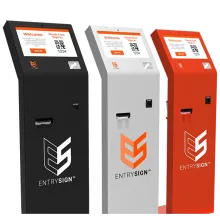
EntrySign is a cloud-based option available through ID Card Centre. It allows real-time monitoring of visitor activity and pulls structured data on demand. EntrySign also has an app, wall screens and kiosks to help make managing the sign-in process even easier and more professional.
Neither system needs to operate in isolation. EntrySign integrates with Active Directory, so staff and visitor lists stay synchronised automatically rather than requiring manual updates, and its RESTful API allows it to connect with door access control, HR, payroll, and management information systems already in place. CardExchange's visitor software is similarly designed to sit alongside existing infrastructure rather than replace it outright.
Both options from EntrySign and CardExchange remove the fundamental vulnerability of the paper sign-in book, exposing visitors' data to anyone who comes to reception. They also make destroying data, record transparency and issuing policy documents much easier to manage.
If You Are Sticking With a Paper Process for Now
A fully digital transition is the cleanest solution for collecting, storing and managing visitor data, but if a paper sign-in book is what you have right now, here are steps you can take to reduce your exposure.
Use a confidential format where each entry is covered or self-concealing before the next visitor signs in. Display a clear, brief notice at the sign-in point explaining what data you collect, your lawful basis for collecting it, how long you retain it, and a contact point for data subject requests. This does not need to be a wall of legal text; a short typed notice laminated to the desk will do the job.
Define your retention period in writing, link it to your wider privacy policy, and implement a procedure for secure disposal of old records. The procedure should be documented so you can demonstrate it during any audit.
Limit the fields in your visitor book to what you can justify. If you cannot explain why a specific piece of information is necessary for a specific purpose, leave it out.
The Practical Next Step
A paper sign-in book is a compliance liability that grows over time and one that can cost your business millions if not managed correctly. Digital visitor management systems make it significantly easier to ensure GDPR compliance is a natural function of the process rather than a manual discipline layered on top.
Browse our visitor management systems and software to see the options available for businesses of different sizes, including scalable software from CardExchange and Semieta. If you'd like help finding the right system that suits your volume of visitors and your current setup, speak to the ID Card Centre team directly. We can help you identify a solution that is fully compliant from day one and actually workable for your reception team.
About the Author

Finley Barter
New Business Sales Executive
Finley Barter is a go-to expert for all things ID card printers and personalised lanyards, helping customers choose the right print solutions and branding options with confidence. Whether you're setting up a new system or upgrading your event materials, Finley ensures everything runs smoothly – from print quality to lanyard design.