














































Published 21 August 2026
Last Updated 21 August 2026

How to manage student ID card production during enrolment
Enrolment week is the start of the academic year when tens of thousands of people who have never set foot on campus before have to have a new student card to provide identity and access from the first day. It can be a logistical nightmare if not handled correctly.
For the people actually running enrolment, whoever owns registry, IT, or student services, it's one of the highest-pressure logistics exercises the institution runs all year, and the ID card sits right at the centre of it. Putting together a seamless plan can help such an unpredictable week run a bit smoother for everyone.
The challenge of student enrolment
Most identity and access systems are designed to onboard people gradually, but enrolment week doesn't work like that. It's a single, compressed surge: a large proportion of a year's entire new-student population arriving, registering, and needing a working card within the same handful of days.
The scale of that surge is bigger than it might look from inside a single institution. There were 2,863,180 students enrolled at UK higher education providers in 2024/25, and 2025 was a record year for new entrants specifically: UCAS confirmed 439,180 applicants were accepted onto courses, an all-time high, including a record 255,000 UK 18-year-olds. Clearing alone placed 17,640 students on its first day in the most recent cycle, a 5% increase on the year before, which means a meaningful chunk of any institution's new intake isn't even confirmed until days before term starts. A card production process built around a tidy, finalised list simply doesn't survive contact with how modern admissions actually works.
Compliance
For institutions holding a UKVI Student Sponsor Licence, and enrolling international students on that basis, the card isn't just a convenience, it's part of a legal obligation. UKVI requires sponsoring institutions to monitor the academic engagement and attendance of every sponsored student, and many universities do this in practice through card swipe data at lectures, seminars, and campus entry points. If a card isn't produced and active by the time a student is expected to start engaging with their course, that's not just a frustrated fresher, it's a gap in the attendance record UKVI expects the institution to hold.
That obligation has recently tightened. From April 2026, updated UKVI guidance moved sponsor duties beyond simple attendance tracking, requiring institutions to evidence genuine academic engagement with complete, auditable records rather than attendance data alone. Universities that fail to demonstrate sponsored students actually enrolled and engaged risk losing their Basic Compliance Assessment, and with it, the ability to sponsor international students at all. A student who can't be issued a working card on time is, in a very literal sense, a compliance gap from day one, not just an administrative inconvenience.
What needs to be on a student ID card
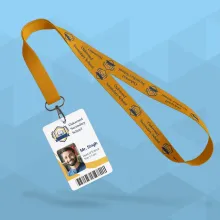
A student card is usually doing more jobs than any other ID card that an institution issues. Depending on the setup, a single card is typically expected to cover:
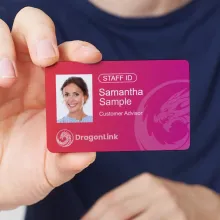
- Photo identification: for exams, campus security, and general identity verification.
- Library membership: borrowing, self-service returns, and access to reference collections.
- Building and door access: halls of residence, labs, libraries after hours, and restricted departments.
- Attendance capture: swipe or tap data at lectures and seminars, which for sponsored international students feeds directly into UKVI compliance reporting.
- Cashless payment: campus catering, vending, and printing credit on many UK campuses.
- Exam identification: many institutions require the card to be presented at every exam sitting, with named fallback procedures (passport, driving licence) if it's lost.
Every one of those functions needs to be live and correctly encoded before the student needs it, which in practice means before, or during, enrolment week itself, not some point in the first fortnight of term.
How to build a student ID production process
Get the data pipeline right
Most card production failures during enrolment trace back to bad data, not bad printing. Names that don't match the student record system, photos submitted in the wrong format, or duplicate records from Clearing placements landing late all cause the same problem: a queue of students at a card desk who can't be issued a card on the spot.
Building a clean, automated feed from the student record or admissions system into the card production software, ideally weeks before enrolment, not the morning of, removes the single biggest source of delay.
Separate the confirmed list from the late arrivals
Institutions with the smoothest enrolment weeks tend to run two parallel tracks rather than one. Confirmed, pre-registered students (the bulk of the intake, known well in advance) get pre-printed, variable-data cards ready to collect on arrival, often in alphabetical batches to speed up queuing.
Clearing placements, late transfers, and data corrections are handled through on-demand printing stations, kept deliberately separate from the main collection point so a slow individual case doesn't hold up a queue of hundreds of students with straightforward, pre-prepared cards.
Plan photo capture as its own workstream
Photo ID is consistently the step that slows enrolment down most, whether it's collecting photos in advance through an online portal, or capturing them on the day. Institutions that ask students to upload a compliant photo during online enrolment, with clear guidance on format and background, before arriving on campus tend to move students through physical collection far faster than those relying entirely on same-day photo booths.
Encode as you print, not afterwards
Where a card needs to work for access control, cashless payment, and library borrowing from the moment it's collected, encoding must happen as part of the print run itself, not as a separate step queued up for later. A card that's printed correctly but not yet encoded for door access is functionally useless to a new resident trying to get into halls on their first night.
Keep a visible buffer of blank stock and staff capacity
However good the pre-registration data is, enrolment week always produces a tail of lost cards, printing errors, and last-minute corrections. Institutions that build in spare card stock, an extra printer, and a dedicated member of staff purely for exceptions tend to avoid the scenario where a single faulty batch or printer jam brings the whole collection point to a halt.
Security features worth it for student ID
Student cards carry more functions, and more risk if compromised, than most general staff ID. A few features are worth treating as standard rather than optional extras:
- Encoded smart chips (MIFARE or similar) for access control and cashless payment, so a visually convincing copy still fails at the point it's actually used.
- Tamper-evident lamination, making it obvious if a card has been peeled apart and a photo swapped.
- UV-visible printing, checkable at exam desks or security points without specialist equipment.
- A clear, fast deactivation process, since a lost or stolen card that still works for building access or cashless spend is a live risk, not just an inconvenience. Most UK universities already charge a standard replacement fee, commonly around £10, partly to offset cost and partly to discourage students from treating card security casually.
In-House Production vs an Enrolment-Week Print Partner
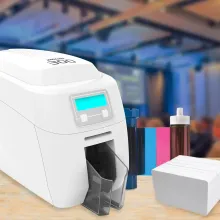
Many institutions run day-to-day replacement and staff card printing in-house, but treat enrolment week differently, because the volume involved rarely matches what a single in-house printer and small team can realistically process in a few days.
Bringing in additional printing capacity, temporary staffing, or a specialist partner for the enrolment surge specifically, while keeping routine production in-house the rest of the year, is a common and sensible middle ground: it avoids paying for enrolment-week-level equipment sitting idle for fifty weeks of the year, without leaving registry staff trying to print thousands of cards on infrastructure built for a much smaller, steadier volume.
How far in advance should student ID card production start for enrolment?
Most institutions begin the data pipeline, pulling confirmed student records and photos, six to eight weeks before enrolment, with pre-printing of confirmed batches happening in the final one to two weeks so cards are ready for collection on day one.
What's the biggest cause of delays during enrolment card production?
Data quality, not printing capacity. Mismatched names, missing or non-compliant photos, and late-arriving Clearing records cause far more delays at the collection desk than the physical print run itself.
Do student ID cards need to double as access control cards?
For most UK universities, yes. A single card typically covers photo ID, library access, building entry, attendance capture, and often cashless payment, which is why encoding has to happen at the point of printing rather than as an afterthought.
None of this requires reinventing enrolment from scratch. It requires treating card production as a data and logistics project that starts weeks before students arrive, not a queue that starts the moment they do. If you're reviewing how your institution handles student ID card production for the next intake, get in touch with the team at ID Card Centre.
We work with UK education institutions on enrolment-period card printing, encoding, and capacity planning, and can help build a process that holds up when thousands of students arrive at once.
About the Author

Ben O'Brien
Managing Director
Ben O’Brien is the Managing Director of ID Card Centre and a recognised authority in complex access control applications and eco-friendly identification solutions. Since entering the ID card printing industry in 1998, Ben has led countless projects across sectors, combining deep technical knowledge with a commitment to sustainability and innovation. Under his leadership, ID Card Centre continues to set standards for secure, efficient, and environmentally conscious ID systems.