























Published 09 October 2026
Last Updated 03 November 2026
In-House vs Outsourced ID Card Production: Which Is Right for Your
Organisation?
Every organisation that issues ID cards face the same
decision between buying a printer and producing cards in house, or sending data
to a specialist and have finished cards delivered? Both approaches work well,
but they suit very different situations, and getting it wrong usually means
either an expensive printer gathering dust or new starters waiting days for a
card they needed on their first morning.
At ID Card Centre, we see both sides every day. Our in-house
bureau produces millions of cards and badges each year for schools,
universities, hospitals, membership clubs, event organisers and retailers, and
we also supply and support ID card printers from all the leading manufacturers.
Because we do both, we have no reason to push you one way, meaning we can set out
the real costs and trade-offs so you can decide what fits best for your
business.
In-house ID card production
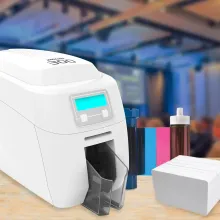
Producing ID cards in-house means owning an ID card printer,
card design software, printer ribbons and blank cards, plus a camera or a way
of collecting photos. Someone in your team designs the template, captures
photos, prints and checks each card, cleans the printer and reorders
consumables. If your cards include a chip for access control, you may also need
an encoder or a printer fitted with one.
Outsourced ID card production
Outsourcing
ID production means using a card printing bureau. You send your design,
staff or student data and photos, approve an artwork proof, and the bureau
prints, encodes if required, quality checks and delivers the finished cards.
Our own bureau handles anything from a single card to jobs of several thousand,
and you'll always receive a proof to sign off before anything is printed.
Can you use both outsourced and insourced production?
Many organisations don't sit neatly in either camp. Some use
a bureau for big batches and keep a small printer for replacements, while
others rent a printer for a project rather than buying one outright.
The real cost of printing ID cards in-house
Upfront equipment
The ID
card printer is the most visible cost, but it isn't the only one. You'll
also need design software, a suitable camera or photo capture process, and
potentially an encoding module if your cards are used for access control. A
single-sided direct-to-card printer is the most affordable starting point,
while a retransfer printer costs more but gives better results on chip cards
and edge-to-edge designs.
Consumables and cost per card
Every in-house card uses a share of a printer ribbon and a
blank card. Colour ribbons are rated for a set number of prints, so the cost
per card depends on your ribbon type and whether you print on one side or both.
It's worth working this figure out before you buy, because it's the number to
compare against a bureau quote. Remember to allow for wasted cards from
misprints, test prints and design changes, which can add noticeably to your
real cost per card in the first few months.
Staff time and hidden costs
The cost most organisations underestimate is time.
Collecting photos, fixing data errors, printing, checking, cleaning the printer, and dealing with jams all add up, particularly at busy times such as the start
of an academic year. Printers also need regular cleaning and occasional
servicing, and if your only printer goes down, card production stops until it's
repaired.
When to choose in-house ID card production
You need cards immediately
If a new starter, a contractor or someone who has lost their
card needs a working ID within minutes, an in-house printer is hard to beat.
This matters most where a card is also a key, for example when it opens doors
or logs people into systems.
You issue cards steadily throughout the year
Organisations with regular staff turnover, rolling
recruitment or frequent visitors get the most from owning a printer. A steady
flow of cards spreads the equipment cost and keeps the team who operate it
practised.
You want card data to stay on site
Printing in-house means personal data and photos never leave
your organisation. For some security-sensitive sites, that level of control is
a deciding factor.
When outsourcing makes more sense
You print in large, occasional batches
If most of your cards are issued at once, such as a
September intake, a rebrand, a site opening or a full re-carding project, a
bureau can produce thousands of consistent cards without tying up your team for
days. Our standard dispatch is 3 to 5 working days, with an express 1-to-2-day
service when deadlines are tight.
Your cards need encoding or specialist finishes
Access control cards need to be printed and encoded
correctly to work with your readers. A bureau with encoding equipment can
supply cards that are printed and programmed in one step, whether they use
proximity or MIFARE technology. That avoids buying an encoder you'd rarely use
and removes the risk of mismatched card formats.
You don't have the time, space or expertise
Small organisations, charities and busy school offices often
don't have someone with time to run a printer well. Outsourcing removes the
equipment, consumables and maintenance entirely, and you only pay for the cards
you order.
Data protection when outsourcing
Sending staff or student data to a bureau means sharing
personal data with a third party, so it's important to get the arrangements
right. Under UK GDPR, the bureau acts as a processor on your behalf, and the
ICO is clear that a written contract must be in place whenever a controller
uses a processor. Before you outsource, check how the bureau receives data, how
long it's kept, and how it's deleted once your cards are printed. A reputable
bureau will be happy to answer these questions.
It also helps to send only the data you actually need on the
card. Our guide to the data we need to print your ID cards explains what to
provide and how to format it.
The hybrid approach most organisations end up with
Bureau for the bulk, printer for the top-ups
This is the approach we see working best in schools,
multi-site organisations and multi-academy trusts. The bureau prints the main
annual batch, encoded and quality-checked, and a compact printer on site
handles new starters, replacements and visitor passes during the year. It keeps
the printer's workload manageable and means nobody waits long for a card.
Renting a printer for short projects
If you need to print on site for a defined period, such as a
construction project, a large event or a temporary recruitment drive, renting
avoids buying equipment you won't need afterwards. Printer rental gives you the
convenience of in-house printing without the long-term cost of ownership.
Questions to ask before you decide on ID card printing processes
How many cards do you issue, and when?
Look at last year's numbers month by month. A large spike
followed by a trickle points towards a bureau or a hybrid approach, while a
steady flow suits in-house printing.
How quickly does someone need a card after they join?
If a card is needed on day one and you can't always plan
ahead, you'll want at least some in-house capacity.
Do your cards need to work with access control?
If they do, find out what technology your readers use before
choosing either route. Encoding is where most costly mistakes happen, so this
is the question to settle first.
Who would run the printer?
A printer only saves money if someone has the time and
training to use it properly. If that person is already stretched, outsourcing
may be cheaper in practice even when the cost per card looks higher.
Is it cheaper to print ID cards in-house?
It can be, but only at the right volume. Once you include
the printer, software, ribbons, wasted cards and staff time, in-house printing
is usually most cost-effective for organisations issuing cards regularly
throughout the year. For low volumes or occasional batches, outsourcing is
often cheaper overall.
How long does outsourced ID card printing take?
At ID Card Centre, standard dispatch is 3 to 5 working days
from artwork approval, with an express 1 to 2 day option. Same-day dispatch may
be possible depending on the job.
Can a bureau print and encode access control cards?
Yes. A bureau with the right equipment can print your design
and encode cards to match your access control system, so they're ready to use
as soon as they arrive.
What do I need to print ID cards in-house?
You'll need an ID card printer, design software, compatible
ribbons and blank cards, and a way of capturing photos. If your cards are used
for access control, you may also need an encoder or compatible chip cards.
Can I use both in-house and outsourced printing?
Yes, and many organisations do. Using a bureau for large
batches and a small printer for replacements and new starters often gives the
best balance of cost, speed and convenience.
Making the right choice
There's no universal answer to the in-house vs outsourced
question, because it depends on your volumes, your timescales and the people
available to do the work. For many organisations, the best result comes from
combining the two rather than choosing one.
If you'd like a second opinion, get in touch with our team.
We'll look at how many cards you issue and how they're used, and recommend the
approach that genuinely suits you, whether that's a printer, our printing
service, or a mix of both. You can also get an instant quote through our online
card builder.
About the Author

Ben O'Brien
Managing Director
Ben O’Brien is the Managing Director of ID Card Centre and a recognised authority in complex access control applications and eco-friendly identification solutions. Since entering the ID card printing industry in 1998, Ben has led countless projects across sectors, combining deep technical knowledge with a commitment to sustainability and innovation. Under his leadership, ID Card Centre continues to set standards for secure, efficient, and environmentally conscious ID systems.