
















Published 16 November 2026
Last Updated 17 November 2026
The Lowdown on Lanyards: Materials, Printing and Types Explained
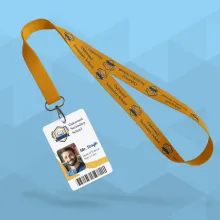
Lanyards are used on a daily basis in healthcare, education, exhibitions, conferences and other events. Although lanyards nearly always display identification cards or entry passes, they often also have to hold mobile devices, other gadgets and/or car keys.
This guide covers the main lanyard materials, which ones can be recycled, the difference between plain, pre-printed and personalised lanyards, and how screen-printing compares with dye sublimation printing.
Where does the word ‘lanyard’ come from?
Lanyards used to be called lanière in 15th-century France. Lanière roughly translates to strap. French soldiers used their lanières to keep their weapons close at hand for close combat or when boarding ships. Over time, the lanyard has gone from being a lifeline to carrying ID cards.
The evolution of the lanyard continues. Today they can be made from a vast range of materials, can be branded, patterned or plain, and can carry a host of different types of attachments: cards, keys, mobiles or 15th-century military memorabilia.
What are lanyards made of?
Lanyards are often made of polyester, but there are more interesting and environmentally friendly lanyard materials that we provide. For example, would you consider bamboo or recycled PET (polyethene terephthalate)?
Here’s the lowdown on lanyard fabrics:
- Polyester lanyards are the most widely used because polyester is the most cost-effective option. These lanyards can be flat, tubular or woven. It’s extremely versatile: screen printing, dye sublimation printing, or woven polyester designs are all possible.
- Bamboo lanyards are an environmentally friendly alternative to polyester lanyards. Bamboo grows incredibly rapidly and is one of the most sustainable natural resources available. It also absorbs carbon dioxide and releases 35% more oxygen than most hardwood trees. Bamboo also has anti-bacterial qualities, so it’s ideal for lanyards in catering and medical environments.
- PET lanyards are made from a mixture of highly recyclable plastic resin and a form of polyester. PET is also used in the packaging industry because it’s so widely recycled. PET lanyards can be disposed of in general recycling bins or reused.
Can lanyards be recycled?
Some of our lanyards are entirely recyclable or biodegradable, but some have recyclable or biodegradable content, making them tricky to process.
Lanyards that combine different materials, such as a fabric strap with metal or plastic fittings, can’t always go in household recycling. For the most eco-friendly disposal, take them to your local recycling centre, or reuse them for future events and new starters.
Plain, Pre-Printed or Personalised Lanyards?
The right choice depends on your budget, how quickly you need them and how visible you want your brand to be.
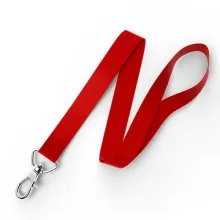
Plain lanyards
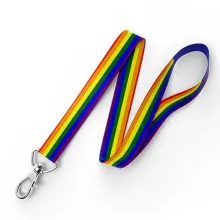
Plain lanyards are the most cost-effective option. They are popular with the public sector, charities and fundraising events. At large events, plain lanyards in different colours can identify roles at a glance, such as medics, security, catering staff and volunteers. This helps security teams control access to restricted areas, especially at outdoor events.
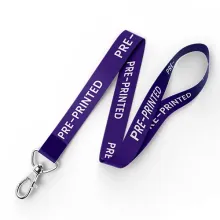
Pre-printed lanyards
Pre-printed lanyards carry a role or title, so staff can spot who’s who in busy areas. We keep these designs in stock for fast dispatch:
- Staff
- Visitor
- Student
- Volunteer
- Temporary
- Contractor
- Governor
- Parent
- Security
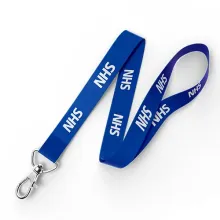
- NHS
For healthcare settings, see our range of NHS lanyards.
Personalised lanyards
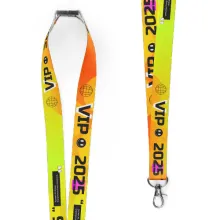
Personalised lanyards carry your logo, name or event branding. Businesses use them to give employees, visitors and contractors recognisable passes. Conference and exhibition organisers use them, so delegates and exhibitors match the event they’re attending. This is especially useful at venues that host several events at once, such as the NEC in Birmingham.
Screen Printing or Dye Sublimation
Personalised lanyards are often screen printed or dye sublimation printed. If you can tell us about how you’d like your lanyards branded, we can tell you which option would best suit your needs.
Screen-printed lanyards go through the same process as screen-printed cloth, a technique that’s always been popular in the clothing industry. Lanyards can be screen printed up to 4 times. Each screen print is a single-colour design that can be felt if you run your finger over the lanyard’s fabric.
Dye sublimation is a print process that covers the whole lanyard. It accommodates Pantone colour matching and intricate designs. Lanyards that have been printed on with dye sublimation are smooth and have a silky appearance, so the lanyards look more upmarket compared to the screen-printed versions.
Personalised lanyard lead times
Our standard lead time for personalised lanyards is up to 20 working days from artwork sign-off. If you need them sooner, our express service delivers in 3 or 5 working days from artwork sign-off. All express orders are printed using dye sublimation.
Not sure which option suits your design? Tell us how you’d like your lanyards branded and we’ll recommend the best print method.
Find the right lanyards for your organisation
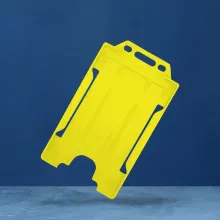
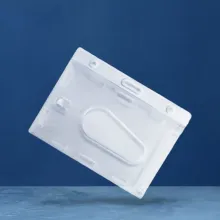
Whichever lanyard you choose, there’s a wide range of materials, widths, styles and colours, each with a different finish. Browse our full range of lanyards, pair them with ID card holders, or contact our team for advice on 01604 422 422.
About the Author

Ben O'Brien
Managing Director
Ben O’Brien is the Managing Director of ID Card Centre and a recognised authority in complex access control applications and eco-friendly identification solutions. Since entering the ID card printing industry in 1998, Ben has led countless projects across sectors, combining deep technical knowledge with a commitment to sustainability and innovation. Under his leadership, ID Card Centre continues to set standards for secure, efficient, and environmentally conscious ID systems.